

In premium retail, a mannequin is never a neutral fixture. Its pose, proportions, surface material and color shape how a customer reads a brand before they touch a single garment. That is why leading fashion brands now plan mannequins together with store design, lighting and window concepts — not as an afterthought once the fit-out is complete.
In traditional retail, mannequins were treated as functional tools: dress the garment, show the fit, let customers see how clothing looks on a body. But as retail shifts toward spatial experience and brand recognition, that role is changing. For fashion brands, boutiques, department stores and visual merchandising teams, a good mannequin is no longer just “a body that wears clothes.” It is part of the brand’s visual language.
What Customers Actually See: One Impression, Not Separate Props
A customer standing in front of a store does not analyze each element of the window separately. They see a whole. Clothing, lighting, backdrop, props, spatial proportion and the mannequin’s posture combine into a single visual impression.
The same garment on different mannequins can communicate completely different brand feelings:
- A mannequin with sharp body lines and a strong pose reinforces an avant-garde, architectural, fashion-forward identity.
- A mannequin with natural proportions and a restrained stance creates a quiet, premium, long-term feeling.
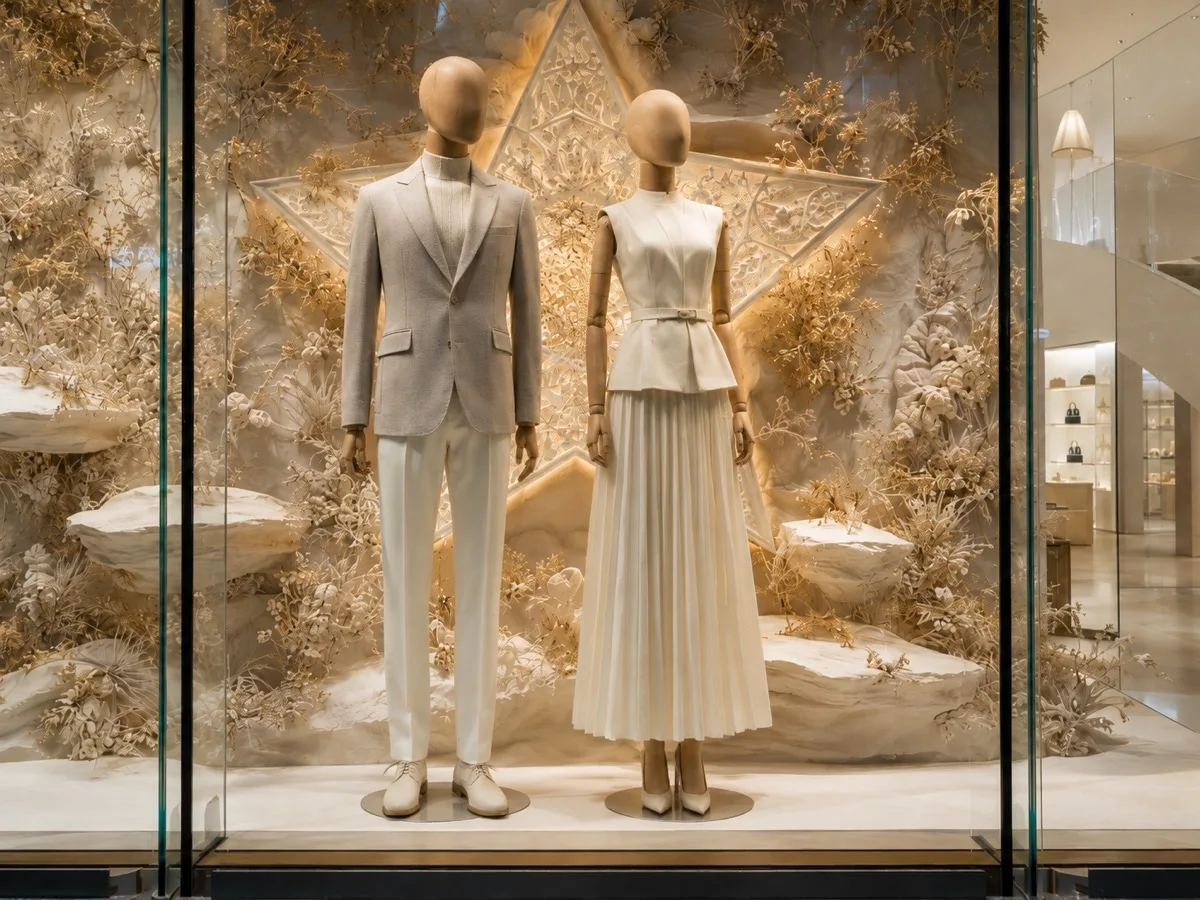
- A fabric-covered surface, natural wooden arms and soft neutral tones make a space feel warmer, more tactile, more handcrafted.
Choosing a mannequin is therefore also choosing how the brand wants to be perceived.
How Poses Build a Silent Narrative in the Window
In a mature visual merchandising project, mannequins rarely stand alone. Several mannequins form relationships: one faces the street, one turns sideways, one holds a slight sense of movement, one stays still. Together, these poses create a silent narrative — much like photography or stage design.
If every mannequin uses the same standard pose, even excellent clothing can look mechanical. When different poses form a rhythm, customers naturally start to wonder: Who are they? What are they doing? What is this collection trying to say?
Pose selection is not simply model selection — it is part of spatial storytelling. This is why, in a custom mannequin project, body pose, head angle, arm position and center of gravity are worth confirming at the start of the project, not at the end. See our guide to approving a custom mannequin pose before bulk production.
Why Surface Material Is a Brand Language
Beyond posture, the mannequin’s surface directly affects the atmosphere of a store.
Traditional painted mannequins give clean, modern, clearly defined silhouettes. A fabric-covered mannequin offers a different experience: the textile surface avoids harsh reflections and brings a softer, more tactile presence to the space. The fabric itself can change the mannequin’s character — linen feels natural; fine knits and high-density weaves feel restrained; warm grey, off-white and light brown blend easily into interiors built from natural wood, stone and soft lighting.
Getting this right is a craft question as much as a design one. Each textile behaves differently on a complex form, so tension, seam placement and surface finishing are controlled by hand to keep the fabric smooth while preserving the silhouette, and the internal structure and base are built to stay stable through seasonal display changes in long-term retail use.
Add articulated wooden arms, a wooden neck cap or custom-finished metal parts, and the mannequin becomes part of the store’s material system. At that point, a brand is no longer buying an isolated product — it is sourcing a display element that belongs to the interior design. This is exactly how projects like our Loro Piana window display were built: linen surfaces and adjustable beech arms chosen to match the brand’s material world, not just to hold the clothing.
For a deeper look at material decisions, see how buyers choose fabric texture and how to match fabric colors to a store interior.
What Customization Really Means for a Brand
Custom mannequins are often understood as: change the size, pick another color, adjust the arms or modify the pose. But for a real brand project, the core of customization is not creating more difference — it is removing unnecessary visual conflict.
A mature customization process should answer questions like:
- What materials dominate the brand’s stores?
- Is the space warm or cool in tone?
- Does the collection need natural or dramatic poses?
- Should the mannequin be a focal point, or recede so the clothing is the absolute hero?
- Will the same series need to be reproduced across stores and countries for years?
These answers determine not only how the mannequin looks, but how it is manufactured, which materials are used and which quality standards apply. A valuable mannequin supplier is not one that says “we can make that color.” It is one that understands why a color suits a space — and how to reproduce the same result consistently, order after order. This is why we recommend approving a material board before production and planning for finish consistency across multi-store rollouts.
From a Single Prop to a Visual Merchandising System
Online shopping handles search, comparison and purchase. The physical store keeps one advantage that cannot be replaced: spatial experience. Customers physically feel material, proportion, light, scale and the mood a brand creates.
Within that system, the mannequin sits exactly between the clothing and the space. It carries the garment, and at the same time it belongs to the architecture, the interior and the visual merchandising concept.
A successful mannequin project therefore rarely starts with “which models do you have?” It starts with: what brand experience should this store deliver? Only then come the practical decisions — body proportions, pose combinations, surface material, fabric color, wooden arms and components, base structure, production consistency, and repeatability across stores. Considered together, the mannequin stops being a simple display item and becomes a long-term visual asset in the brand’s spatial design.
How Should Brands and VM Designers Choose Mannequins?
Comparing unit price, dimensions and lead time is not enough for a long-term store program. Four questions matter more:
- Does the design coordinate with the brand’s spaces — materials, tones, proportions?
- Can the supplier adapt size, pose, material and structure to the project, or only offer fixed stock models?
- Will bulk production stay consistent with the approved sample?
- Does the supplier understand how retail projects are actually delivered?
A mannequin may take days to install, but it will represent the brand in stores for years. Short-term purchase price is not the only cost — what matters is whether the mannequin can represent the brand reliably over time. Our professional guide to choosing mannequins for fashion brands covers the full evaluation process.
From Displaying Products to Expressing the Brand
Clothing will always be the heart of a fashion store, and a mannequin should never compete with it for attention. But the right mannequin lets clothing, space and brand form a more complete relationship. It does not need to speak loudly. Through a pose, a material, a color and its proportion to the space, it quietly tells customers what kind of brand this is.
That may be the most important value of mannequins in modern retail visual merchandising: they no longer just display products. They take part in the brand’s story.